Tracing Roulette Chip Material Innovations from 19th-Century Workshops to Embedded Tracking Features in Today's Mobile Casino Platforms
Written by Freya Becker · Sep 21, 2026

Tracing Roulette Chip Material Innovations from 19th-Century Workshops to Embedded Tracking Features in Today's Mobile Casino Platforms
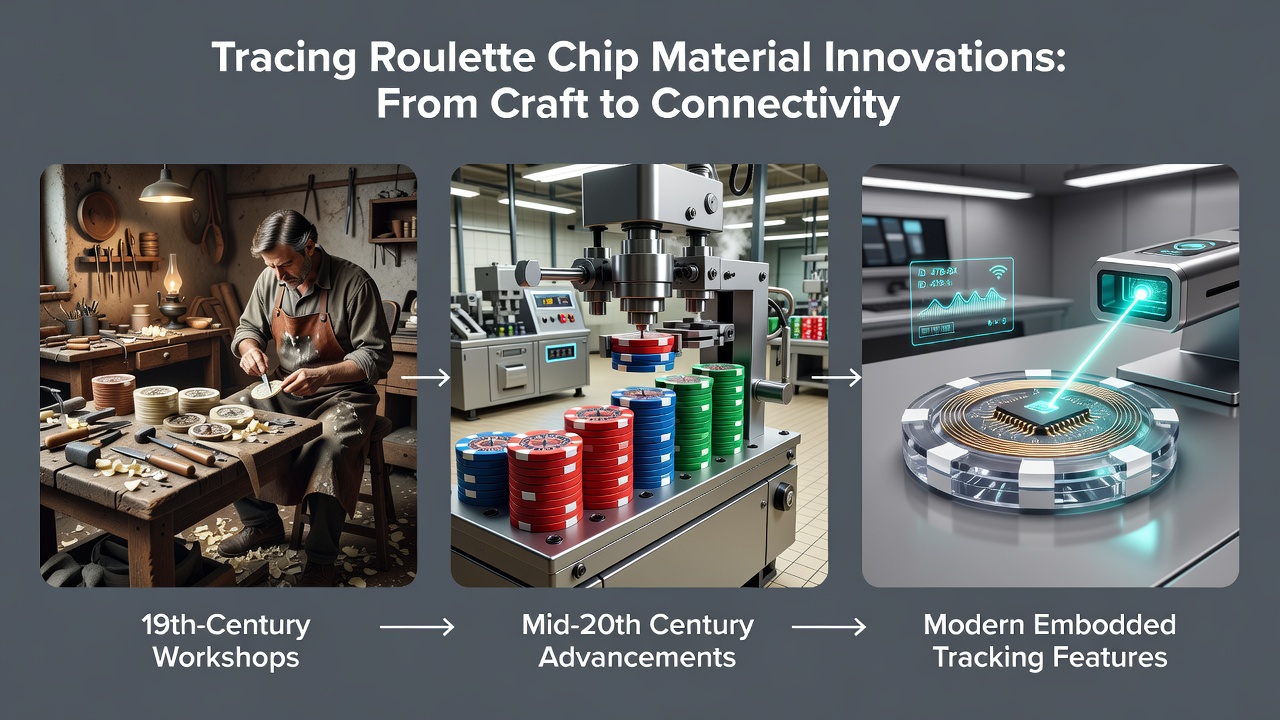
Workshops across Europe in the 1800s produced roulette chips primarily from clay composites blended with bone dust and natural dyes, while some high-end sets incorporated ivory blanks turned on lathes and engraved by hand. These early pieces carried distinctive weights and textures that allowed dealers to verify authenticity through touch alone, and manufacturers documented their processes in ledgers that recorded batch compositions and firing temperatures. Observers note that such methods persisted into the early 20th century even as demand rose with the spread of casino resorts in the United States and on ocean liners.
By the 1920s, American suppliers shifted toward molded clay and later thermoplastic resins that offered greater durability and consistent sizing across large production runs. These changes coincided with the introduction of standardized color schemes and edge markings that casinos adopted to speed up payouts and reduce disputes at crowded tables. Researchers have traced supply chains showing how resin formulas evolved to resist chipping and fading under bright casino lights, while still maintaining the precise diameters required for stacking in dealer trays.
Material Shifts in Mid-Century Production
After World War II, injection-molding techniques allowed for the embedding of metal slugs inside chips to achieve specific weights without relying on dense natural materials, and this approach reduced costs while increasing uniformity across thousands of units. Factories in the Midwest and later in Asia refined these processes through the 1960s and 1970s, incorporating ultraviolet inks and micro-etchings that remained invisible under normal light yet became detectable with simple verification tools. Data from industry archives indicates that such security features helped limit counterfeiting incidents at major properties during periods of rapid expansion in Las Vegas and Atlantic City.
Introduction of Electronic Identification
Electronic tracking arrived in the 1990s when manufacturers began embedding passive radio-frequency identification tags into the core of physical chips, enabling automated inventory counts and real-time movement logs within casino cages and on gaming floors. These RFID systems operated at low frequencies that penetrated stacks of chips without requiring line-of-sight readers, and operators integrated the data streams with existing surveillance networks. One study revealed that early adopters reported measurable reductions in shrinkage after deploying the technology across roulette and other table games.
Regulatory bodies in multiple jurisdictions began requiring detailed documentation of chip serial numbers and RFID signatures, and manufacturers responded by developing encrypted tag protocols that resisted cloning attempts. Figures from the Nevada Gaming Control Board outline specifications for chip construction that include minimum tag read ranges and resistance to environmental interference from nearby electronic equipment. Casinos in other regions followed similar guidelines while adapting them to local enforcement priorities.
Transition to Digital and Mobile Platforms
Software developers extended the same tracking logic to virtual chip representations in mobile casino applications, where each digital token carries metadata that mirrors the RFID identifiers used in physical sets. These embedded features allow platforms to log every transfer between player accounts and game servers, creating audit trails that satisfy compliance checks without physical handling. Industry reports note that mobile implementations often combine server-side databases with device-level encryption to prevent duplication or unauthorized transfers during live sessions.
Developers have integrated geofencing and session tokens that align with the verification principles first established in 19th-century workshops, albeit through entirely different technical means. Research from academic gaming centers shows that such layered authentication reduces certain categories of fraud while supporting high-volume play across global user bases. Operators continue to refine these systems in response to evolving standards issued by agencies in Canada and Australia, where testing protocols emphasize both security and uninterrupted user experience.
Conclusion
The progression from handcrafted clay and ivory pieces to chips containing embedded RFID tags and onward to metadata-driven virtual tokens reflects consistent priorities around durability, verification, and accountability. Manufacturers and platform providers have adapted production techniques and software architectures in parallel, preserving core functions of identification while expanding scale and speed. Records maintained by regulatory authorities and technical standards organizations document these incremental changes across more than a century of development.